
Agricultural Technology Creates Bumper Harvests
In 2025, China's agricultural sector brimmed with innovative vitality. Breeding innovations continuously broke high-yield records, and smart agriculture accelerated the reconstruction of production models, promoting a deep transformation of agricultural production from "experience-driven" to "technology-driven."
Precise seed breeding
China's breeding technology underwent a revolution in precise design. A number of new varieties with high yield, quality, resistance and efficiency were bred and promoted, safeguarding domestic food security.
The Institute of Genetics and Developmental Biology of the Chinese Academy of Sciences developed GEAIR (Genome Editing combined with AI-based Robotics), the world's first intelligent breeding robot capable of automatic cruise and cross-pollination.
GEAIR, which can identify stamens with 85 percent accuracy, takes only 15 seconds to complete pollination, said Xu Cao, a researcher at the Institute, adding that this technology saves more than 25 percent of the cost in tomato breeding and has shortened the breeding period from five years to one year.
In 2025, Northwest A&F University in Shaanxi, northwest China, saw 12 new wheat varieties it had developed with breakthroughs in lodging resistance receive national approval. The wheat varieties developed by the university have been grown in around 120 million hectares.
"Wei Liangyou 2268," the new insect-resistant and high-yield rice variety, was developed using molecular design breeding technology. It has achieved a yield of 1,174 kilograms per mu in its demonstration plot in Hunan province in central China.
AI management
In 2025, AI has been deeply integrated in agricultural scenarios, and agricultural large models have achieved multiple breakthroughs and large-scale applications, making the transformation of agricultural production precise, unmanned and green.
In a vegetable greenhouse in Changping District, Beijing, a robot using the "Shennong Large Model" is used to check the fruits and vegetables. If it detects a bacterial leaf spot, for instance in the lettuce, it immediately alerts the pest and disease identification agent for diagnosis. It triggers the irrigation agent to adjust the water and fertilizer ratio, reducing labor costs by 30 percent.
The Shennong Large Model is also applied to diagnose livestock and poultry diseases, and has over 100,000 users in Inner Mongolia, Shanxi, and other areas.
Chinese company Weichai Lovol has released the first industrial AI large model in China that focuses on the dual scenario of "intelligent agricultural machinery + smart agriculture." It is used in over 70 smart farms across the country, covering more than 633,000 hectares.
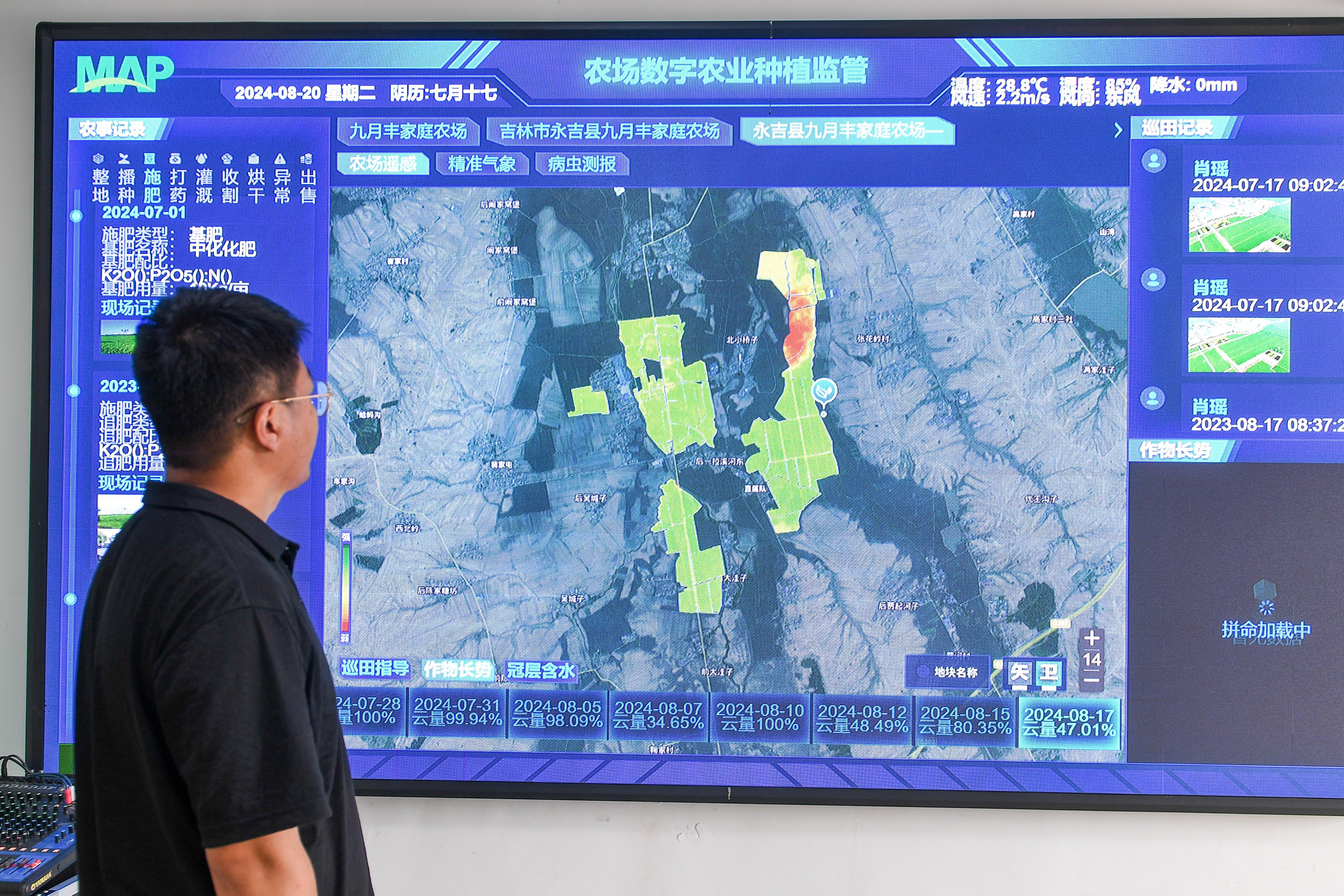
The first version of a comprehensive planting large model, "iMAP," is undergoing application verification in major grain-producing areas such as Inner Mongolia and northeast China. The cumulative pilot area for crops like corn is now 67,000 hectares.
China's grain output in 2025 reached 715 million tonnes, up by 1.2 percent year on year, with agricultural scientific and technological progress contributing over 65 percent of the growth rate.
The coverage of high-quality seeds is over 96 percent, and the application of intelligent agricultural machinery increased by 38 percent year on year.