
Harmonious Coexistence of Subways and Springs
Building subways is nothing new, but building subways through a karst spring area is a formidable challenge.
Jinan in eastern China is called the "City of Springs" for its roughly 1,200 natural artesian springs. However, its karst geology also makes it one of the most fragile environments for underground construction.
It took more than 30 years to construct subway lines in the city while protecting its springs, from conception to reality.
Priority for spring protection
Jinan conceived of building a subway as early as the 1980s. In the 1990s, a professional institution was established to conduct investigations and research.
However, in 2002, experts from the Chinese Academy of Sciences, the Chinese Academy of Engineering and other institutions suggested, after detailed discussions, that the rail transit project should be delayed.
Also, at that time, the iconic Baotu Spring in downtown Jinan stopped flowing and the protection of springs became the priority. Hence the rail transit plan was put on hold.
Subsequently, as China's spring protection knowledge and technology advanced, the construction of a subway in Jinan was taken up again. In 2009, the survey and design team of the project proposed building the subway by circumventing the karst aquifers of the springs.
In July 2015, construction of Jinan's first subway line began in its western urban area. After three and a half years, it started running. Built far from the cluster of springs, the first line provided experience for the following lines passing through the urban area.
Empowered by technology
A series of technical difficulties had to be resolved, such as passing under the Beijing-Shanghai High-speed Railway and crossing the Jining-Hefei Expressway Bridge. It had also to be ensured that tunneling in the karst area with "water-rich high-strength limestone" could be done safely. Once these challenges were overcome, the project was fast-tracked.
With the accumulation of technology and experience, lines 1, 2 and 3 of the first-phase project were completed, forming an H-shaped rail transit network around the main urban area. The second phase, based on a deeper understanding of the geological structure, has entered the core area of the city. Line 4 is the first metro line close to the spring cluster.
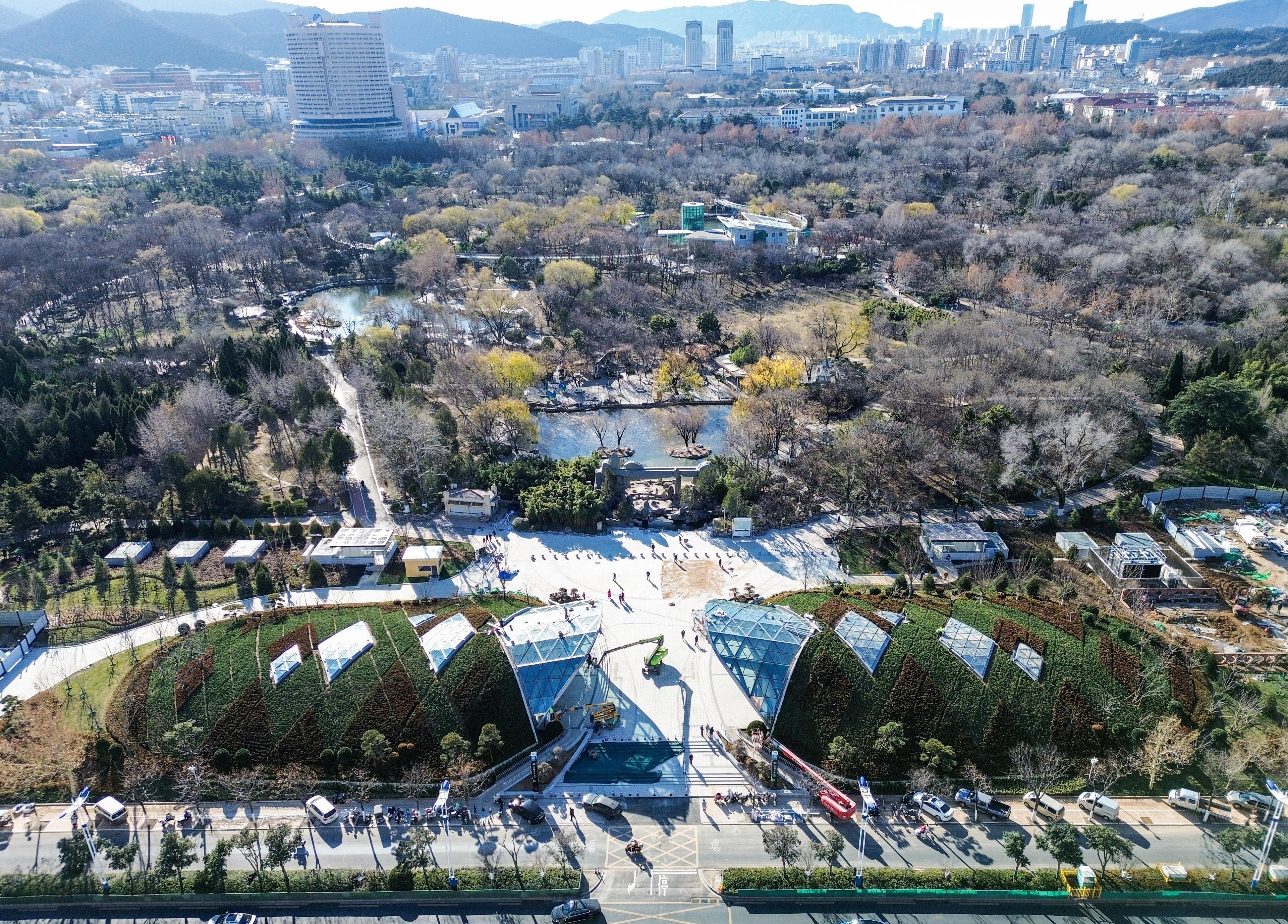
The Quancheng Park Station on Line 4 is the only one above ground to avoid the aquifer. If the groundwater level rises during the rainy season, the excess water would flow into the diversion channel beneath the station floor, explained Li Hu, general manager of Jinan Subway.
To analyze the geological characteristics of the area, the project team have accumulated geological data and hydrological conditions since the 1950s and 1960s and established an intelligent four-dimensional geological platform for the spring area.
While crossing the karst spring area, a new type of "anti-dynamic water sealing material" was used to quickly solidify and block the leakage point when encountering sudden water gushing.
Another new "anti-dynamic water high flow retention material" can remain in the set position during groundwater erosion, preventing the slurry from expanding.
Long-term monitoring
What impact does the construction of subways have on underground springs? In 2025, monitoring data showed that the water level of the Baotu Spring reached 30.32 meters, the highest recorded since 1966.
Jinan will continue long-term monitoring of the groundwater level and analyze the dynamics of the springs. A closed-loop system has been established for spring protection, covering the entire process from planning, construction to operation, ensuring the harmonious coexistence of the subways and the spring water.
Li said the Jinan Rail Transit Group has established over 200 long-term groundwater monitoring stands, forming a complete monitoring system with 24-hour real-time monitoring of the groundwater level along the metro lines. This data can also be used to protect the springs and develop urban underground space in the future.
The Shandong Provincial Bureau of Geology and Mineral Resources has developed a groundwater monitoring system platform that can issue centimeter-level fluctuation warnings 15 days in advance. It can also visualize and quantify karst water transportation.
Jinan is now planning the third phase of its urban rail transit. The harmonious running of subway trains along the flowing springs will continue in the "City of Springs."