
Shield Machines Rendezvous under Yangtze River
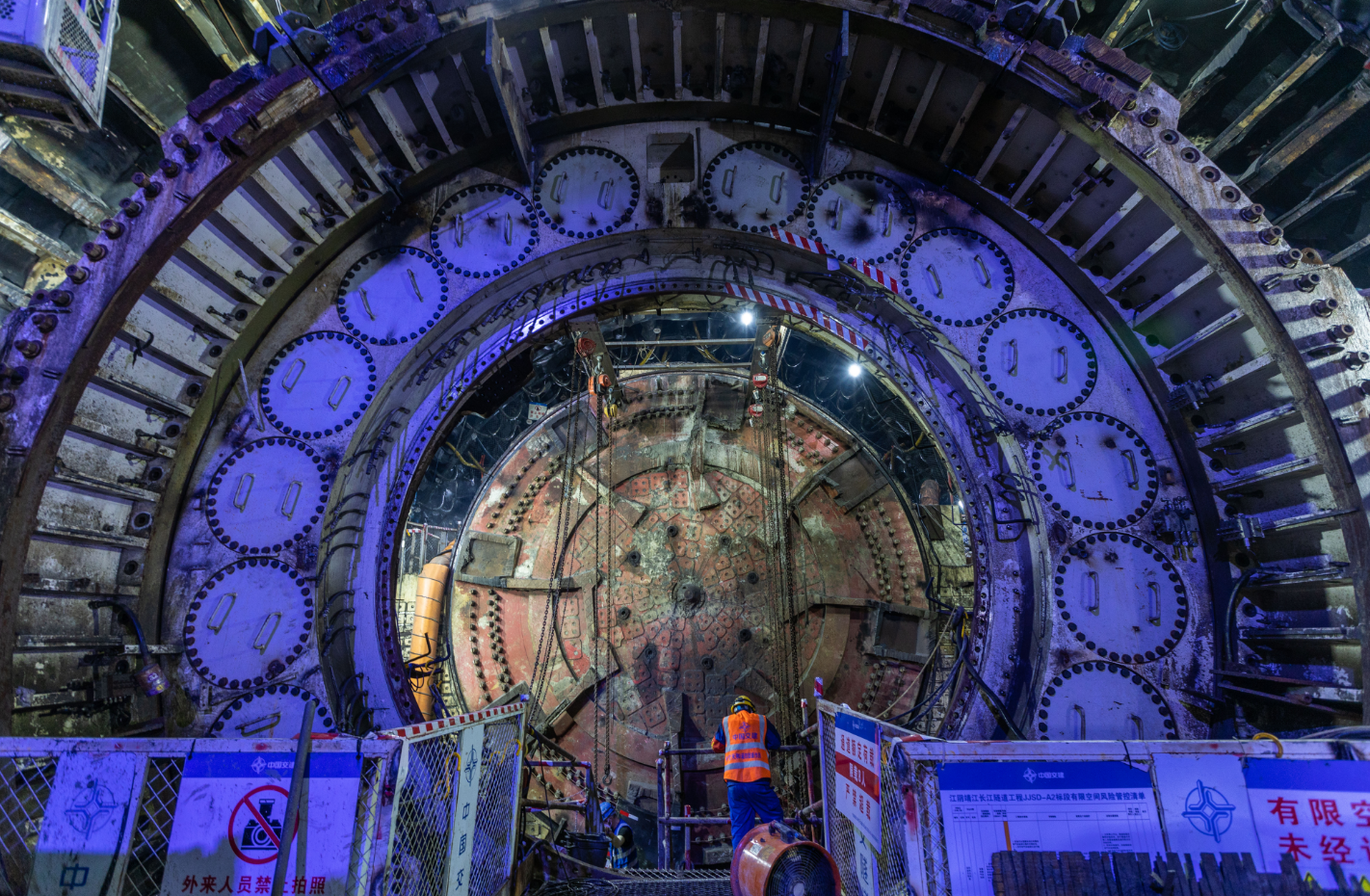
Under the lower tributaries of the Yangtze River in China's eastern Jiangsu province, the "riverbed docking section," or completion of the Jiangyin-Jingjiang Yangtze River Tunnel, was officially celebrated recently.
Constructed by China First Highway Engineering Co., Ltd. (CFHEC), the successful completion of this major infrastructure project, conquering the world-class challenge of a shield-tunnelling machines rendezvous beneath the mighty Yangtze's riverbed, despite being confronted with high water pressure and highly permeable strata, is a defining breakthrough in modern engineering.
Bold decision
In February 2023, during the excavation of the 6.4km tunnel, the shield machine unexpectedly encountered an accident and was unable to continue moving forward. After much deliberation, the project team of CFHEC made a bold decision to use a new shield machine from the other side of the river, to recover its stranded twin and make a rendezvous beneath the riverbed.
CFHEC principal engineer Yao Zhanhu said the biggest challenge in the rendezvous was to ensure that the new shield machine could accurately find its direction in the geological environment of high-pressure, water-rich and sandy strata with surging undercurrents.
"We have developed a visualization system, installing cameras and various sensors on the shield machine to collect real-time data and information about the surrounding environment, achieving all-round monitoring of the tunneling process," said Zhang Lei, deputy manager of the project.
In the summer of 2024, the two shield machines closed in on the critical moment of docking. On the surveillance screen, the "cross" bullseye symbolizing the target gradually coincided. The rendezvous between the two was achieved with just 2mm of vertical error and no horizontal deviation.
Control of the water
A successful rendezvous was only the first step. Surrounding the two shield machines was the soft and unstable soil layer rich in groundwater. To carry out subsequent construction in the section, it was necessary to control the strata where the undercurrents surged.
"One of the best ways to control water is to freeze it." After conducting systematic argumentation, Academician Chen Xiangsheng of the Chinese Academy of Engineering accepted the asymmetric freezing method proposed by the project team.
The basic approach of this method is to install over 300 freezing pipes from the interior of the shield machine to cool and freeze the water-rich stratum, solidifying it into an "ice barrier" to ensure the safety of the subsequent connection.
However, when water freezes, it causes volume expansion. The expansion caused by over 300 pipes can squeeze the shield machine and the tunnel. So, it was vitally important to make sure that the freezing tubes could extend precisely to the designated position.
The team made a 1:1 model and organized the simulation training, repeatedly optimizing the selection of drilling tools, adjusting drilling parameters, and perfecting their operation skills. Finally, after more than five months of preparation, the 363 boreholes for the freezing pipes were successfully completed. The deviation of the hole opening angles was all controlled within 0.2 degrees, far exceeding the designed standard.
The interwoven frozen pipelines were deeply embedded in the soil, building a solid "barrier" 3.9 meters thick with an average stable temperature of -13℃.
Removing the shield machines
The construction process then reached the most critical step in the later stage — disassembling and extracting the shield machines.
As both shield machines were unable to be lifted out, they could only be cut and disassembled inside the tunnel. High-intensity cutting and welding generate a large amount of heat, which could have affected the newly formed frozen soil, said the project manager Liang Yuqiang.
Meanwhile, large machinery could not enter the tunnel due to the limited space, and all cutting and transportation work had to be done manually. Like "ants moving house," two shield machines, each weighing several thousand tons, were disassembled and transported out by hand, bit by bit.
On March 26, 2025, the construction teams on both sides met each other beneath the riverbed. On November 29, 2025, the main structure of the tunnel was completed, marking the full connection of the Jiangyin-Jingjiang Yangtze River Tunnel.
No safety accidents occurred throughout the entire construction process. The team's exceptional skills and and courage transformed an unforeseen setback into a historic breakthrough in global tunnel engineering construction.