

Science Serves Society, Progress in Human Dignity
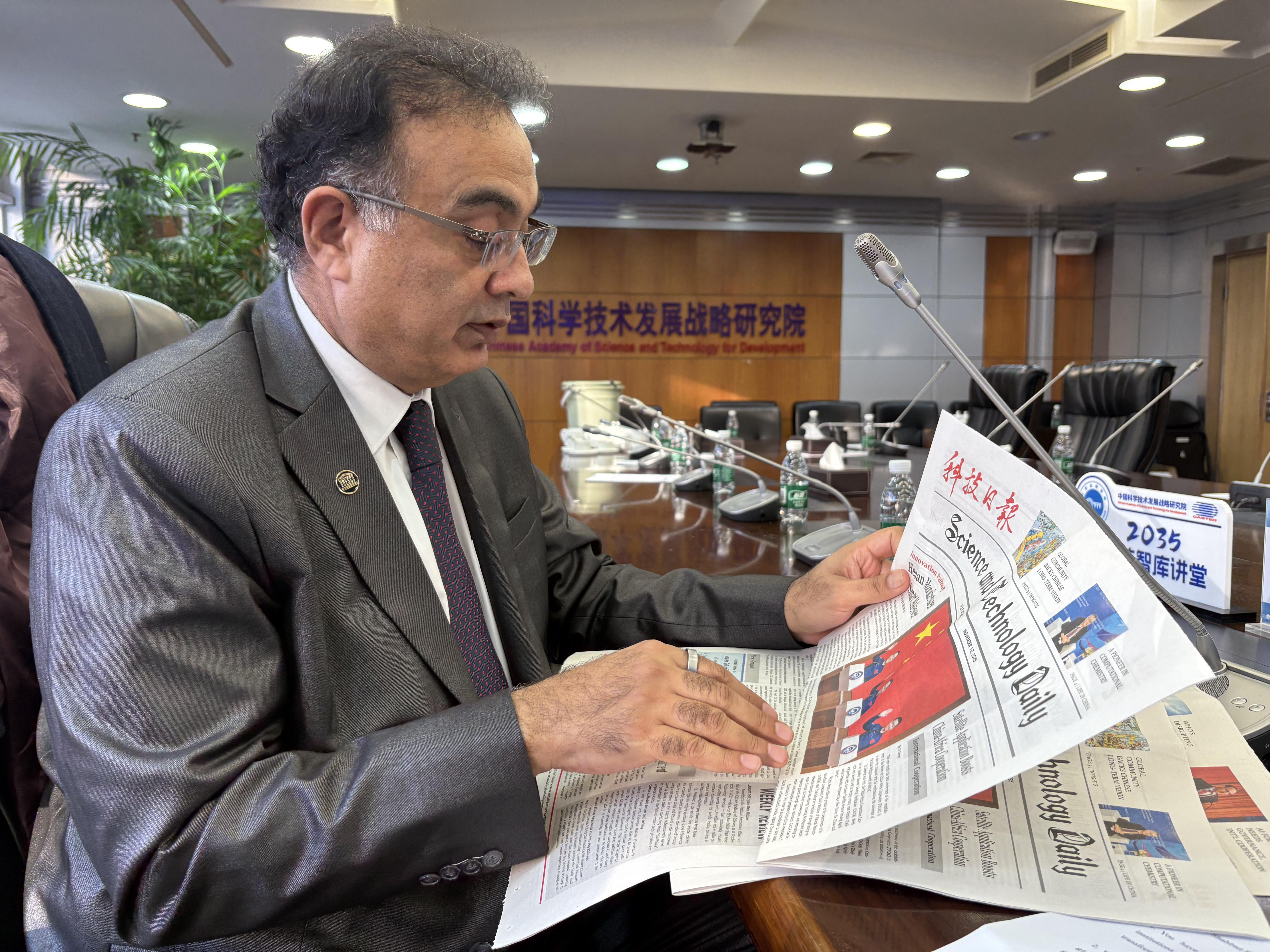
"When the value created by a product stays where it's made through jobs, skills, and fair wages…that's what I mean by shared prosperity," said Shahbaz Khan, director and UNESCO representative to the Regional Office for East Asia, holding up his smartphone during a lecture at the China Academy of Science and Technology for Development (CASTED).
The device was a Realme, a brand born in China but assembled by young workers in Lahore, Pakistan. "I bought it there because I needed a phone that works in Pakistan," he said with a knowing smile. "But more importantly, local people are employed, trained and earning. That's not extraction. That's partnership."
In an interview following his lecture, Khan gave his version of the China story with his personal observation.
From catching up to setting the pace
"I've been coming to China since 1999," Khan began, recalling his early work on water-saving technologies and irrigation systems. "At that time, China was still catching up with the rest of the world." Back then, scientific infrastructure was developing, research output was modest, and innovation was largely reactive.
Today, the landscape is unrecognizable. "Now, the world is trying to catch up with China," he said.
He pointed to the scale of transformation: massive R&D investment, hundreds of young scientists collaborating in institutions like the Chinese Academy of Sciences, and universities in Wuhan, Beijing and Shenyang operating like "engines of discovery."
The quality of research, publications, and technological output has surged across fields from solar energy and electric vehicles to robotics, nanotechnology, medical sciences and quantum computing.
But what distinguishes China's rise, Khan emphasized, is its integration of sustainability and inclusivity. "It's not just about building high-tech hubs. It's about cleaning polluted rivers, restoring lakes, improving air quality, and shifting entire industries toward ecological sustainability."
Equally important is how China has diffused the benefits of innovation beyond megacities. "Science and technology are reaching rural villages, small towns and remote provinces, lifting 800 million people out of poverty through systemic, tech-enabled development."
He cited Taobao as a quiet revolution in inclusive economics. "I use it for almost every purchase," he said. "Order a computer part from Shenzhen, and within days it arrives at my door in Beijing."
Behind that convenience lies a deeply integrated digital ecosystem: manufacturers, logistics networks, payment platforms, and last-mile delivery riders connected through information and communication technologies. "And it links consumers directly to primary producers," he added.
Shared prosperity, not zero-sum competition
Does China's rapid technological ascent pose a threat to other countries? "Not really. China's science and technology is not a threat because China is promoting shared prosperity."
He returned to the Realme example. "The same model appears in solar panel factories in Kenya, electric vehicle supply chains in Thailand, and vocational training centers across Africa supported by Chinese partnerships." Students from the Global South come to China, acquire engineering or AI expertise, and return home to contribute to joint ventures. "These aren't extractive relationships. Knowledge, jobs and profits stay where they're created."
China's industrial scale has driven down global prices, creating competitive pressure, but "competition isn't the same as threat. What matters is intent. And China's intent, as I've observed it over the years, is cooperation."
Given China's size, its environmental progress benefits the entire planet. "Global challenges, like climate change, water scarcity and AI ethics, do not respect borders. They require political goodwill and concrete action. In that context, China's contributions through South-South cooperation, UNESCO programs, and institutions like CASTED are invaluable."
Where ancient heritage meets quantum ambition
Even after more than two decades of close engagement, China continues to surprise him. "What still amazes me is the consistency of effort," he said. "People work hard and they also cherish family, tradition and festivals. During Spring Festival, you see red packets, fireworks and reunions. There's a balance between ambition and humanity."
Equally striking is how China harmonizes deep cultural roots with frontier innovation. "Take Zhejiang province as an example, it is home to Liangzhu, a World Heritage site over 5,000 years old, representing one of the world's earliest hydraulic civilizations, jade craftsmanship and social complexity. And it's also where DeepSeek, a leading AI company, is headquartered."
"How can a civilization honor Liangzhu while racing ahead in quantum computing, microchips and AI? That coexistence of memory and momentum is uniquely Chinese. It never stops amazing me," he said.
For Khan, China is a living model where science serves society, innovation lifts communities, and progress is measured not just in patents or GDP, but in human dignity. "That's the beauty of China," he said.